ClaimChain
Blockchain-verified motor insurance claims settlement
The Problem
India's motor insurance claims process has a structural trust failure. A workshop quotes ₹85,000 for repairs. The surveyor approves ₹48,000. The insurer settles at the surveyor's number. The policyholder pays ₹37,000 out of pocket and has no recourse. The gap isn't a bug - it's the system working as designed. Every piece of evidence is created unilaterally by a party with financial skin in the game. Workshops inflate bills by 20-40%. Surveyors face pressure from insurers who assign them repeat work. Insurers benefit from lower estimates. Four parties, four truths, zero shared record.
Key Decisions
- ▸Blockchain over a centralized database - and here's why. A SaaS platform would solve the UX problem but not the trust problem. If the insurer builds the system, workshops won't trust it. If a startup builds it, insurers won't accept it as evidence. Five conditions all had to be true for blockchain to be the right call: low trust between independent parties, no politically acceptable single owner, shared mutable state across the claim lifecycle, legal consequences where tamper-evidence matters (admissible under BSA 2023 Section 63), and measurable value from disintermediation. All five were met.
- ▸AI as a core pillar, not a post-launch feature. Without an independent damage estimate, ClaimChain is just a timestamping tool. The AI assessment - a neutral "third opinion" biased neither by workshop inflation nor surveyor filtering - is what gives the evidence certificate negotiating power. We used GPT-4o Vision for damage assessment with a separate judge model (Claude Sonnet) to avoid self-evaluation bias, and built a three-tier evaluation strategy: rubric scoring, automated assertion checks, and human eval against real surveyor estimates. Ran 4 prompt versions against a 17-case golden dataset before deploying — measuring cost overlap with ground truth, severity calibration, hallucination rate, and edge-case safety.
What I Shipped
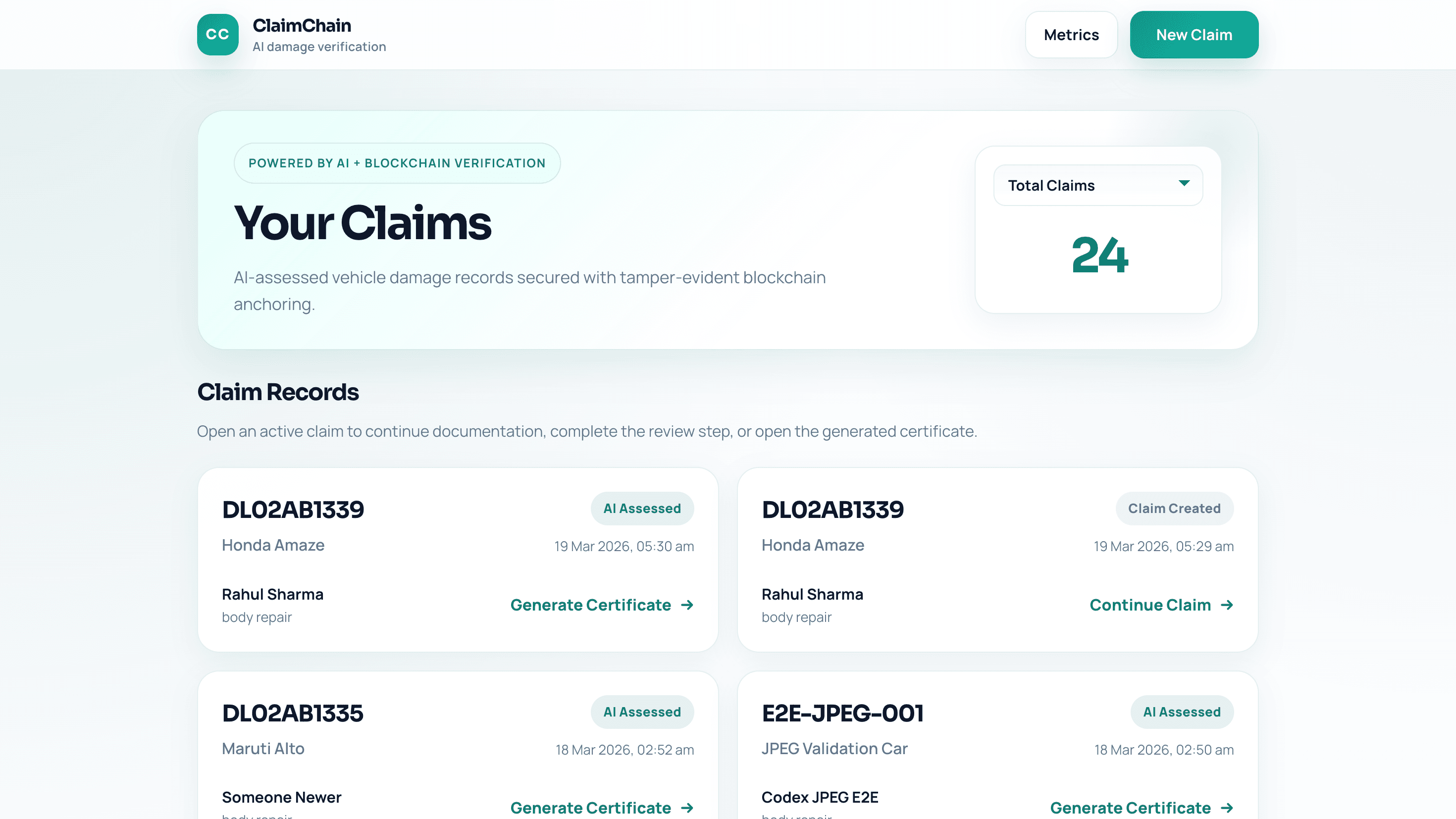
- ▸A workshop owner opens the app, uploads 2+ damage photos, and gets back a Damage Evidence Certificate in under 90 seconds. Behind the scenes: each photo is hashed with timestamp, GPS, and device ID, then anchored to Polygon Amoy via Merkle tree batching. The AI analyzes damage and generates an independent repair estimate. The certificate is shareable with surveyors and insurers as tamper-proof documentation.
- ▸The blockchain is invisible to users. They see a green checkmark saying "Tamper-proof, verified" with a link to verify on-chain. That was a deliberate design choice - the technology matters for system integrity, but the user experience should hide it completely.
- ▸Live at claimchain-mvp.vercel.app
Results
- ▸Shipped a fully functional MVP with AI damage assessment, blockchain verification, and certificate generation. The product demonstrates the full flow: photo upload → AI analysis → blockchain anchoring → shareable Damage Evidence Certificate.
Reflection
I had a blockchain course in my program, but building ClaimChain is what made it click. Implementing Merkle tree batching and anchoring hashes to Polygon Amoy took it from theory to something I could reason about at a system design level. On the AI side, this project was my starting point for thinking seriously about evaluation. It's easy to ship an AI feature that works in a demo - getting it to produce consistent, defensible output across messy real-world inputs is a different problem. Iterating across 4 prompt versions taught me that prompt engineering hits a floor (some failure modes are model-level, not prompt-level), and that judge calibration matters as much as the prompts themselves. That's where I started building the habit of treating eval as a product concern, not an afterthought.